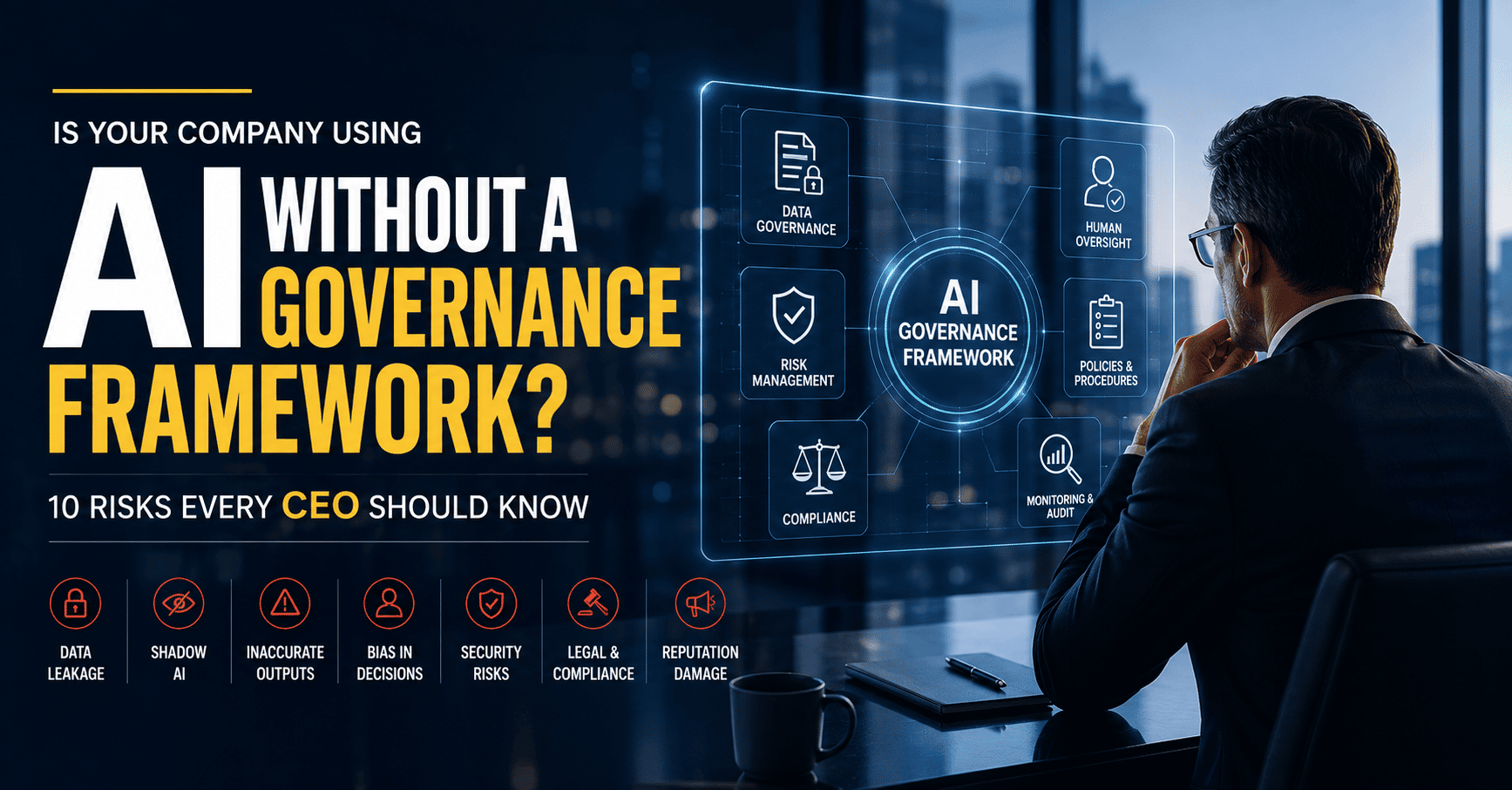
10 Risks Every CEO Should Know
Artificial intelligence has entered the corporate world through an unusual route. Unlike previous waves of enterprise technology, it has not always arrived through a major procurement decision, a board-approved transformation programme or a carefully managed IT implementation. In many companies, AI arrived through employees.
A marketing executive began using ChatGPT to develop campaign ideas. A manager discovered that an AI assistant could summarise a 40-page report in seconds. A sales team started using generative AI to draft proposals. Someone in HR experimented with AI to review CVs. A finance executive uploaded a spreadsheet to an AI platform and asked it to identify trends. Before long, artificial intelligence became part of everyday work.
For many organisations, this happened before senior management had time to ask a more fundamental question: What exactly are our people using AI for, and who is governing it?
That question is becoming increasingly important for CEOs, boards and senior management teams. AI can improve productivity, accelerate analysis and reduce repetitive work. It can also expose confidential information, produce inaccurate business intelligence, introduce bias into decisions and create legal, cybersecurity and reputational risks.
The issue is not whether companies should use AI. Most organisations will increasingly have little choice if they want to remain competitive. The issue is whether AI adoption is taking place within an AI Governance Framework that gives management visibility and control.
For a CEO, the following ten risks deserve particular attention.
1. Your Employees May Already Be Sharing Confidential Information With AI
Imagine a senior manager preparing for an important client meeting. The manager has a confidential 30-page proposal and wants a quick summary of its commercial strengths and weaknesses. Instead of spending an hour reviewing it, the document is uploaded to a generative AI platform.
The result appears within seconds.
From the employee’s perspective, this is productivity. From the company’s perspective, however, another event has taken place: commercially sensitive information has been transferred to an external technology platform.
The same situation can occur with contracts, customer databases, pricing structures, employee information, financial projections, tender documents, internal reports and strategic plans. Employees do not necessarily act irresponsibly when this happens. In many cases, nobody has told them where the boundaries are.
That is where the absence of an AI Governance Framework becomes visible. If an organisation has not established rules covering approved AI platforms, confidential information and acceptable AI use, employees are left to make their own judgement. For CEOs, this is an important distinction. The organisation may have excellent cybersecurity policies and strict access controls while confidential information quietly leaves the business through perfectly normal AI usage.
2. Shadow AI Can Spread Across the Organisation Before Management Notices
Corporate IT departments have spent years dealing with “shadow IT” — software and applications adopted by employees without formal approval. Generative AI has accelerated the same problem.
Consider a company with 300 employees. The marketing department subscribes to one AI writing platform. The sales team experiments with an AI prospecting application. HR begins testing an AI recruitment tool. A senior executive connects an AI assistant to meeting notes. Several employees use their personal accounts on free generative AI platforms.
None of these decisions appears significant in isolation. Together, they can create an uncontrolled AI ecosystem.
Management may not know which systems are operating, what company information they process, which external vendors have access to corporate data or whether employees are relying on AI outputs when making important decisions. This is why one of the first components of effective AI governance is surprisingly simple: know what AI your organisation is actually using.
An organisation-wide AI inventory can reveal approved systems, unofficial applications, departmental experiments and AI features already embedded within existing software. Without that visibility, management is attempting to govern something it cannot see.
3. The Most Dangerous AI Error May Look Completely Professional
One of generative AI’s greatest strengths is also one of its greatest corporate risks: it can communicate with extraordinary confidence.
An inaccurate answer does not necessarily arrive with a warning. It may appear in polished language, organised into a professional structure and supported by references that look credible. For an employee under pressure, that presentation can create false confidence.
Now consider where the information might travel next. An AI-generated statistic appears in a management presentation. An inaccurate interpretation enters a tender response. A fabricated source finds its way into a research report. An AI-generated financial assumption becomes part of a proposal presented to investors.
By the time someone discovers the mistake, the organisation may already have acted on it.
This is why AI governance cannot rely on a simple rule that employees should “check AI-generated information.” Different applications carry different levels of risk. Drafting a routine internal announcement does not require the same oversight as analysing a contract, preparing financial information or supporting a decision about an employee.
A mature AI Governance Framework establishes risk-based human oversight. The greater the potential consequence, the stronger the verification process should become.
4. AI Is Quietly Becoming a Data Governance Issue
A company may think it has a strong privacy programme because customer information sits behind passwords, databases have access controls and employees receive data protection training.
Then AI enters the workflow.
An HR employee asks an AI system to compare several CVs. A customer service executive uploads a complaint history and asks for a summary. A manager feeds employee performance information into an AI assistant. A sales team uses customer data to generate personalised communications.
Suddenly, personal information is being processed in ways that the organisation’s original data governance structure may never have anticipated.
The questions for management become more complex. Where is that information processed? Does the AI provider retain it? Can the provider use the information for another purpose? Who can access it? Has the company assessed the vendor? Does the organisation have an appropriate process for allowing employees to use personal data in this way?
For Sri Lankan companies, these questions are becoming particularly relevant as organisations strengthen their approach to personal data protection and digital compliance. AI governance cannot sit in one corporate silo while privacy sits in another. The two increasingly overlap. Any serious AI Governance Framework should therefore connect AI approval with existing privacy, information security and data management controls.
5. The Content Your Company Creates With AI May Carry Hidden Intellectual Property Risks
Generative AI has rapidly become a production tool. Companies now use it to create images, advertisements, website content, presentations, software code, product concepts and corporate communications.
The speed is attractive. The ownership questions are less straightforward.
A marketing team may generate an image and immediately place it in a national advertising campaign. A developer may incorporate AI-generated code into a commercial platform. A content team may publish AI-generated material without checking whether it closely resembles existing work.
Employees can easily assume that anything generated by an AI platform belongs to the company and can be used commercially without further consideration.
That assumption deserves scrutiny.
Different platforms operate under different terms. Questions may arise around ownership, licensing, originality, third-party rights and permitted commercial use. These issues become more significant when AI-generated material forms part of a valuable corporate asset or a major public campaign. The governance solution is not to prohibit generative content. It is to establish a review process appropriate to the commercial significance of the output.
6. AI Can Influence Decisions Without Appearing to Make the Decision
When people discuss AI governance, they often imagine an autonomous computer making major corporate decisions. The reality is usually more subtle.
AI may simply recommend which candidates deserve interviews. It may rank sales prospects. It may identify customers considered more likely to default. It may analyse employee performance. It may suggest which complaints require escalation.
A human still makes the final decision. But the AI has already shaped the options presented to that person.
This distinction matters because bias or weakness in the underlying system can influence business outcomes without management recognising that AI played a meaningful role. Recruitment provides a clear example. If an AI-supported system consistently ranks certain profiles more favourably because of patterns in its data or methodology, the final hiring manager may unknowingly inherit those assumptions.
The executive question should therefore not simply be, “Does AI make decisions in our company?” A better question is: “Which important decisions are influenced by AI?” Once management identifies those areas, it can apply appropriate testing, documentation and human oversight.
7. When Something Goes Wrong, Accountability Can Become Surprisingly Difficult to Find
Suppose an AI-generated recommendation leads to a significant business error.
Who is responsible?
The employee who used the system may say the organisation approved the platform. IT may say it only manages technical access. The department head may say nobody told the team that the particular use required approval. Compliance may say it was never informed that the system existed.
The technology provider, meanwhile, may have contractual terms limiting its responsibility.This is where AI risk becomes a corporate governance issue.
Traditional management structures work because responsibility can usually be traced. AI can blur those lines when technology, data, employees and external vendors all participate in the same process.
A credible AI Governance Framework should establish clear ownership. Someone must have responsibility for approving higher-risk AI applications. Departments should know when they need approval. Senior management should know who receives reports about significant AI risks and incidents.
For larger organisations, this may justify an AI governance committee or cross-functional working group involving technology, legal, compliance, cybersecurity, HR and business leadership.
For smaller companies, the structure can be simpler. What matters is that accountability exists.
8. AI Can Create New Cybersecurity Doors Into Systems You Already Protect
Many companies have invested heavily in cybersecurity. They control employee access, protect databases, manage cloud environments and monitor corporate devices.
AI applications can introduce new connections into that environment.
An employee connects an AI assistant to corporate email. Another application receives access to cloud documents. A sales tool integrates with the CRM. An AI meeting assistant gains access to calendars and conversations. More advanced AI agents may eventually receive permission to perform actions on behalf of employees.
Each connection may offer legitimate productivity benefits.
Each connection can also expand the company’s technology risk surface.
The question is no longer simply whether an AI tool is useful. Management also needs to know what permissions it receives, which systems it can access, what information it can retrieve and how quickly access can be revoked.
An organisation that carefully controls access to its internal systems but allows employees to connect unassessed AI applications to those systems has created a gap between cybersecurity policy and actual behaviour.
AI governance should close that gap.
9. The Public Will Blame Your Company, Not the Algorithm
Consider a corporate chatbot that gives a customer incorrect information about a service. Or an AI-generated advertisement that contains a misleading claim. Or a company article that publishes a fabricated statistic.
When the problem becomes public, explaining that “AI generated it” offers little protection to the organisation’s reputation.
Customers see the company name.
Investors see the company name.
Regulators, business partners and journalists see the company name.
This makes external AI-generated communication particularly important from a governance perspective.
Companies should establish approval thresholds based on the significance of the communication. A low-risk social media draft may require ordinary editorial review. Financial claims, legal statements, regulated information, investor communications and major corporate announcements should receive considerably stronger scrutiny.
AI may generate the first draft. Corporate accountability remains human.
10. The Biggest Risk Is the Gap Between AI Adoption and Corporate Governance
The previous nine risks point towards a broader problem.
AI adoption moves extremely quickly.
Traditional enterprise systems usually pass through procurement, budgeting, implementation and training before employees begin using them. Generative AI often reverses that process. Employees start using the technology first. Governance arrives later.
That creates what may become one of the defining corporate governance challenges of the AI era: the AI governance gap.
The company is already using AI. Productivity gains are already appearing. Departments are already experimenting. Information is already flowing through new systems.
But policies, accountability, risk classifications and management oversight remain months behind.
The longer this gap continues, the harder it becomes to regain visibility.
For CEOs, waiting until the organisation has a major AI project before establishing governance may therefore be the wrong approach. By that stage, dozens of smaller AI applications may already be operating throughout the business.
What an Effective AI Governance Framework Actually Looks Like
The phrase AI Governance Framework can sound like another layer of corporate bureaucracy. It should not become one.
A practical framework should make responsible AI adoption easier, not harder.
It begins with visibility. Management needs an inventory of AI systems already used across the organisation, including standalone applications and AI functionality embedded within existing software.
The organisation then needs to classify those applications according to risk. A tool that helps employees improve grammar should not face the same approval process as a system that analyses customer information or influences recruitment decisions.
Clear policies should establish what employees can do with AI, which platforms the company approves, what information must never be uploaded and when human review becomes mandatory.
Vendor assessment should form another layer. Before an AI platform gains access to company information or systems, the organisation should understand how the provider handles data, security, access and retention.
Accountability must then sit above the process. Departments need to know who approves higher-risk AI applications, who owns the organisation’s AI policy and who reports material issues to senior management or the board.
Finally, employees need training.
This last point matters because AI governance will fail if it exists only as a policy document stored somewhere on the corporate network. Employees need practical guidance that reflects how they actually work.
AI Governance Should Enable Adoption, Not Stop It
There is a temptation for companies facing a new category of risk to respond with prohibition.
That would be a mistake.
Employees use AI because it solves real problems. It can reduce administrative work, improve research, accelerate communication and help organisations extract more value from information. Companies that attempt to block every form of AI usage may simply push employees towards unofficial tools and deepen the shadow AI problem.
The stronger approach is controlled adoption.
Give employees approved tools. Define clear boundaries. Protect sensitive information. Establish stronger oversight for higher-risk applications. Train people to verify important outputs. Keep management informed about how AI use evolves across the organisation.
In other words, governance should provide the infrastructure that allows AI adoption to scale responsibly.
The Boardroom Question Has Changed
A few years ago, a CEO might reasonably have asked the technology team whether the company planned to use artificial intelligence.
That question is already becoming outdated.
The better question today is:
“Where is AI already being used across our organisation, and do we have adequate control over it?”
If management cannot answer that question with confidence, the organisation does not necessarily have an AI problem. But it probably has an AI visibility problem.
And visibility is where governance begins.
An AI governance assessment can help organisations identify existing AI usage, shadow AI applications, data exposure risks, approval gaps, high-risk use cases and areas where policies need strengthening. From there, management can build an AI Governance Framework that reflects the organisation’s actual operations rather than imposing a generic policy.
Artificial intelligence will continue to move deeper into corporate operations. It will influence how organisations communicate, analyse information, serve customers, manage employees and make decisions.
The companies best positioned for that future will not necessarily be those that adopt AI fastest.
They will be the companies that know where they are using it, why they are using it, what could go wrong and who is responsible when it does.
For CEOs and boards, that is no longer simply an AI question.
It is a governance question.