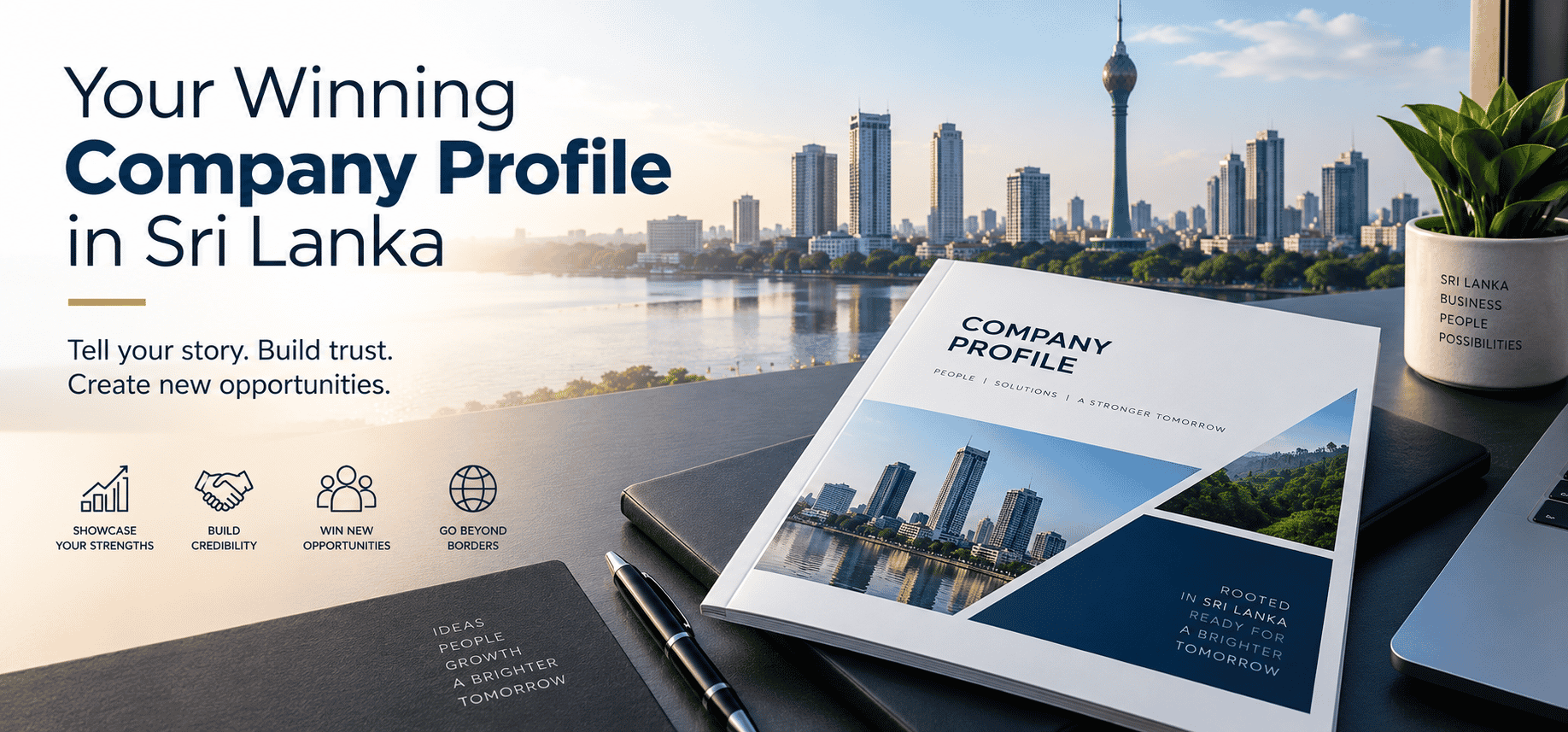
Your Winning Company Profile in Sri Lanka
A business meeting can sometimes begin long before anyone enters the meeting room. A potential client hears your company name through a recommendation, searches for your business online and then sends a simple request: “Please send us your company profile.” At that point, your company may have only a few minutes to establish credibility. The document you send becomes your representative.
This is why developing a professional Company Profile in Sri Lanka requires much more than putting company information into an attractive PDF. A strong profile introduces the organisation, explains its capabilities, demonstrates its experience and positions the business for the opportunity ahead.
For many Sri Lankan companies, the company profile has become an essential business development document. Companies use profiles when approaching corporate clients, submitting proposals, entering tenders, meeting investors, developing partnerships and exploring international markets. The quality of that document can shape how others perceive the business.
The First Impression Starts Before the Meeting
Consider a Sri Lankan engineering company that wants to secure a contract with a large property developer. The company has operated for more than ten years. It has experienced engineers, completed projects and reliable suppliers. Its technical capability is strong.
The developer requests the company profile before arranging a meeting. The engineering company sends an old document created several years ago. It contains long paragraphs, outdated photographs and a basic list of services. Several major projects completed during recent years do not appear anywhere in the document. The business itself may be capable, but its profile does not communicate that capability.
Now consider another company competing for the same opportunity. Its profile immediately explains what the business does, the sectors it serves and the scale of its operations. Project photographs demonstrate experience. Key statistics establish capacity. Certifications support credibility. The document takes the reader through the company logically. The difference is not necessarily business capability. The difference is how each organisation presents that capability. That is where professional company profile development matters.
A Company Profile Should Tell a Business Story
Every organisation has information. Not every organisation has a clear corporate story. Company profiles often become collections of disconnected information. One page explains the history. Another lists services. Another contains a message from the chairman. Several pages show photographs. The final page provides contact details. Everything may be technically correct, yet the reader struggles to understand what makes the company valuable. A winning Company Profile in Sri Lanka needs a storyline.
The story should start by establishing the organisation and its position in the market. It should then introduce the company’s capabilities, explain its experience and provide evidence that supports its claims. Finally, it should leave the reader with a clear understanding of why the organisation deserves consideration. This does not require dramatic storytelling. Corporate communication needs clarity rather than unnecessary decoration. The objective is simple: take the reader from “Who is this company?” to “This company appears capable of handling what we need.”
Start With What the Company Represents Today
Many businesses start their profiles with their incorporation date.
“ABC Holdings was established in 2004…”
The next three paragraphs describe how the company started, who founded it and how it developed. Corporate history has value, but it should not delay the main message. The opening section should quickly explain what the company represents today. For example, a manufacturing company could introduce itself as a Sri Lankan manufacturer serving the construction, hospitality and commercial sectors with locally produced and imported interior solutions.
The reader immediately understands the company’s position. The profile can then explain how the organisation reached that position. This approach becomes especially important when companies use profiles for business development. Senior executives, procurement professionals and investors often review several documents. They need to understand the business quickly.
Move Beyond Generic Corporate Language
Almost every business wants to appear professional, reliable, innovative and customer-focused.
As a result, these words appear repeatedly in company profiles.
“We are committed to excellence.”
“We strive to exceed customer expectations.”
“We provide innovative solutions.”
These statements sound positive, but they provide little evidence. A professional company profile should communicate specific strengths. If the company has completed 250 commercial projects, mention it. If the organisation serves customers across six countries, identify those markets. If the company operates a 50,000-square-foot manufacturing facility, explain the capacity. If its leadership team has decades of combined industry experience, present that expertise. If the organisation holds important certifications, display them clearly. Specific information creates credibility. Instead of repeatedly telling the reader that the company is reliable, the profile should give the reader enough evidence to reach that conclusion.
Explain Capabilities, Not Just Services
Imagine a logistics company profile with this section:
- Freight Forwarding
- Warehousing
- Customs Support
- Transportation
- Distribution
The reader understands the service categories, but learns very little about the organisation’s actual capability.
A stronger profile explains how those services work together.
The company may coordinate international freight, manage warehousing, arrange inland transportation and support distribution through an integrated logistics network. That explanation positions the company as a logistics partner rather than simply a provider of individual services.
The same principle applies across industries. A construction company should communicate project capability. A technology business should explain technical expertise and implementation capacity. A consultancy should demonstrate knowledge and advisory strength. A manufacturer should communicate production capability, quality standards and supply capacity. A professional Company Profile in Sri Lanka should therefore translate a list of services into a clear picture of what the business can actually deliver.
Understand Who Will Read the Profile
A company profile rarely has only one audience. A corporate customer may want to know whether the business can deliver a project. A procurement manager may examine capacity, compliance and previous experience. A foreign organisation looking for a Sri Lankan partner may focus on local knowledge, infrastructure and management. An investor may look at growth, market position and business potential. A bank may consider stability and corporate background.
The company cannot speak to every audience in exactly the same way. Before developing the profile, the business should identify its priority readers. This helps determine which information deserves the greatest attention. A profile designed for tender participation may highlight projects, certifications, technical resources and experience. A profile designed for international partnerships may give greater attention to market presence, management capability, infrastructure and strategic advantages. The strongest profiles understand their audience before they start speaking.
Design Should Make the Story Easier to Understand
Professional design plays an important role, but design should support communication rather than dominate it.
A company profile does not become professional simply because it contains expensive graphics.
Good design creates order.
The reader should know where to look first. Headings should establish clear sections. Important statistics should stand out. Photographs should demonstrate genuine capability whenever possible. Charts and diagrams should simplify information that would otherwise require several paragraphs.
White space also matters.
Crowding every page with text, icons, photographs and shapes can make an organisation appear less professional rather than more established.
The best corporate profiles often feel confident because they do not try too hard.
Strong writing provides the message. Strong design gives that message structure.
Your Company Profile Is Also a Sales Document
Many businesses treat the company profile as an administrative requirement.
Someone asks for it, so they send it.
That approach misses its wider commercial value.
A well-developed company profile can support the entire business development process.
A salesperson can send it before a meeting. Management can use it during partnership discussions. The business can attach it to proposals. Exporters can introduce their organisations to international buyers. Contractors can include relevant information in tender submissions. Professional firms can use profiles when approaching corporate clients.
The profile can even support conversations where the company has not yet met the decision-maker.
In that situation, the document needs to communicate without someone standing beside it and explaining each page.
That is a useful test.
If a decision-maker receives your company profile without any introduction, will the document explain your organisation clearly enough?
If the answer is no, the profile needs further work.
Sri Lankan Companies Are Competing Beyond Sri Lanka
The importance of professional corporate presentation continues to grow as Sri Lankan businesses explore regional and international markets.
A Sri Lankan technology company may pitch to clients in the United Kingdom. A manufacturer may approach distributors in the Middle East. A consultancy may work with organisations in Australia. An exporter may communicate with buyers across Asia and Europe.
These companies compete not only on price and capability but also on presentation.
An overseas prospect may know very little about the organisation before receiving its corporate materials. The website, company profile, proposal and executive communication collectively create an impression of the business.
Therefore, a Company Profile in Sri Lanka intended for international audiences should meet global corporate communication standards while retaining the company’s genuine identity.
It should communicate confidence without exaggeration.
It should demonstrate scale without making unsupported claims.
It should show local strength while presenting the organisation as ready for broader opportunities.
The Profile Must Grow With the Business
A company profile should never remain unchanged for years.
Businesses evolve.
They complete new projects, enter new markets, introduce services, recruit senior professionals, obtain certifications and develop partnerships.
The company profile should reflect those changes.
A business that has grown significantly but continues to circulate an old profile creates a gap between its actual capability and its perceived capability.
Companies should therefore review their profiles regularly.
Some organisations may also benefit from maintaining different versions. A comprehensive corporate profile can serve as the master document. A shorter version can support initial business enquiries. A capability-focused version can support tenders or major proposals.
The message remains consistent, but the depth of information changes according to the audience.
When the Next Opportunity Arrives
Return to the potential client who asks:
“Can you send us your company profile?”
That request may appear routine, but it often signals something more important. Someone is evaluating your organisation. They may be comparing you with competitors. They may be deciding whether to invite you to a meeting. They may be assessing whether your company has the capacity to become a supplier, contractor, consultant or business partner. Your profile now has a job to do.
It must introduce the business clearly, communicate its capabilities, demonstrate credibility and create enough confidence for the conversation to continue. That is what separates an ordinary company profile from a winning one. A professionally developed Company Profile in Sri Lanka does not simply document where your business has been. It presents what your organisation represents today and communicates where it is capable of going next. Your business may already have the experience, people, resources and expertise needed to win the next opportunity. The question is whether your company profile communicates it.