Digital transformation has changed the way companies operate, communicate, sell, collect data and manage customers. In Sri Lanka, even traditionally offline businesses now depend on websites, cloud platforms, CRM systems, social media, email marketing, digital advertising, online payments, analytics tools and artificial intelligence. Yet many organisations have expanded their digital footprint without ever conducting a structured Digital Audit to understand whether these systems are performing effectively, securely and in line with business objectives.
For senior management, this creates a growing blind spot. A company may have invested heavily in digital platforms while still struggling to measure return on investment, control digital assets, manage customer data, maintain brand consistency or understand where vulnerabilities exist. These weaknesses often remain hidden because individual departments continue operating normally. Marketing looks after campaigns, IT manages infrastructure, sales uses the CRM, HR controls recruitment systems and external agencies manage websites or advertising accounts.
The difficulty is that customers and stakeholders do not experience the organisation in those separate departments. They experience one company.
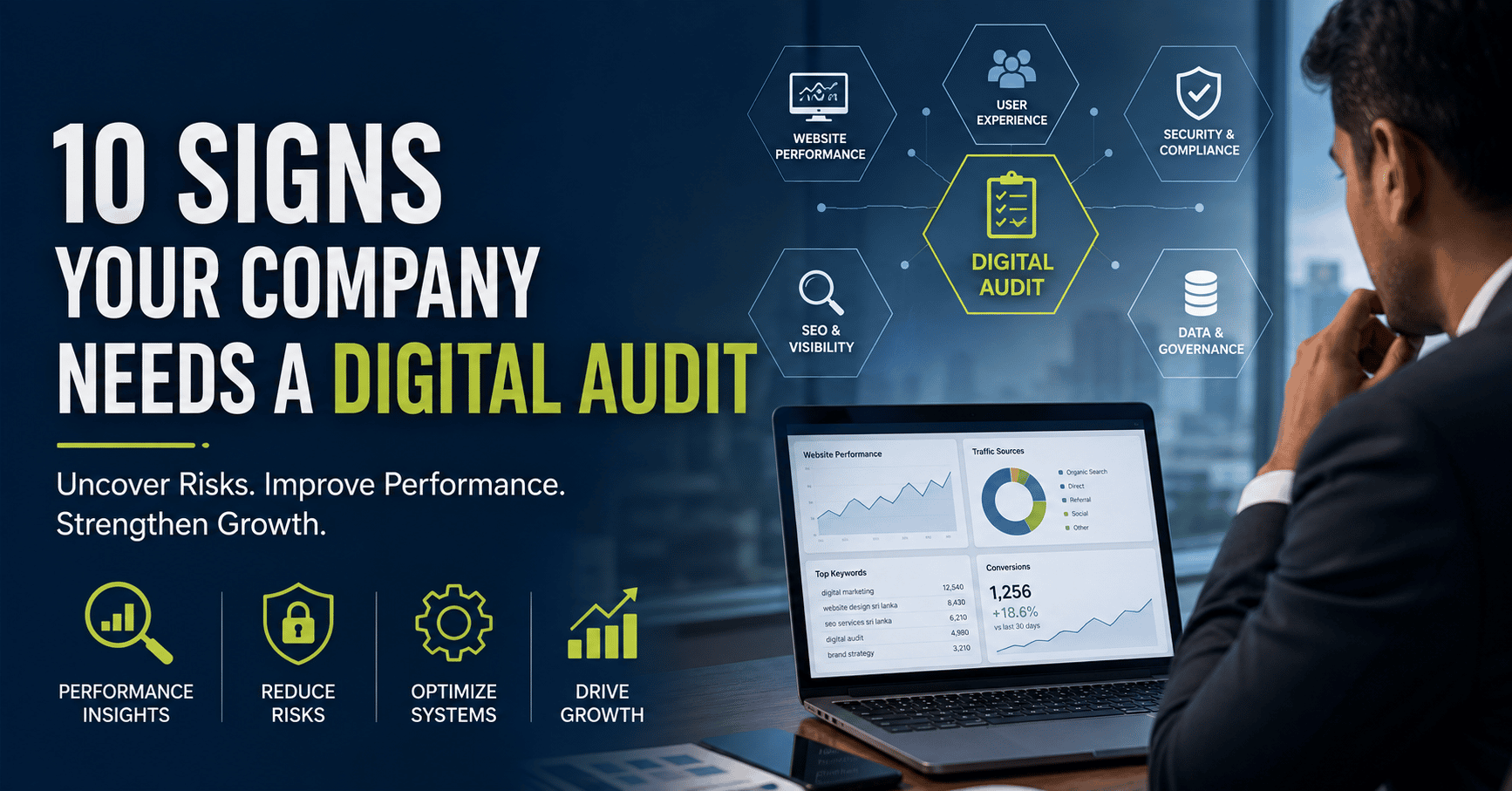
A Digital Audit for companies in Sri Lanka provides management with a consolidated view of the organisation’s digital environment. It examines digital presence, website performance, online visibility, technology platforms, data practices, digital governance, account ownership, cybersecurity indicators, AI usage and measurable business performance. Most importantly, it identifies where digital investment is creating value and where hidden weaknesses may be increasing cost, risk or inefficiency.
If your organisation has grown digitally over the last few years, the following ten signs may indicate that it is time for a comprehensive Digital Audit.
1. Your Corporate Website Looks Good but Produces Few Measurable Results
A professional corporate website is no longer simply an online brochure. For many organisations, it is the first place a potential customer, investor, supplier, employee or business partner goes to assess the company. The website therefore needs to perform a commercial and reputational function, not merely exist.
Many senior management teams can explain when their website was redesigned and how much it cost, but they cannot say how many qualified enquiries it generates, which pages drive conversions or which services attract the highest-value visitors. Others have invested in visually attractive websites without assessing search visibility, mobile performance, user experience or conversion pathways.
This is a common reason to conduct a website and digital presence audit.
A Digital Audit examines whether the website supports the current business strategy. It reviews technical performance, content structure, search engine optimisation, mobile usability, conversion opportunities, analytics implementation and the overall customer journey. It also evaluates whether the information on the website accurately represents the organisation’s present capabilities.
For example, a company may have expanded into new markets, launched new services or repositioned itself internationally, while its website still reflects the business as it existed several years ago. In that situation, the issue is not simply poor design. It is a mismatch between the company’s actual market position and its digital identity.
For senior management, the key question should therefore be simple: Is our website generating measurable business value?
If the answer is unclear, it is a strong indication that a Digital Audit is required.
2. Your Digital Channels Operate Independently With No Central Oversight
Digital environments often become fragmented as companies grow. Marketing manages social media, sales operates a CRM, IT manages hosting and email, HR uses recruitment platforms, finance pays for software subscriptions and external agencies may control advertising or website accounts.
Each function may work efficiently on its own. The problem appears when nobody has visibility across the entire digital ecosystem.
This fragmentation can lead to duplicated platforms, inconsistent communication, wasted subscriptions, disconnected customer experiences and unclear ownership of critical digital assets. It can also create risks when access remains with former employees, agencies or third-party providers.
A corporate Digital Audit helps management create a complete inventory of digital systems, accounts, channels and responsibilities. It identifies which department owns each platform, who has administrator access, how the system supports the business and whether the organisation retains ultimate control over the asset.
This matters because digital operations have become too important to remain dependent on informal arrangements. You should treat Domains, websites, analytics accounts, customer databases and business-critical cloud systems as corporate assets with clear ownership and governance.
If several departments are making digital decisions independently without a common framework, the organisation may already have a digital governance problem.
3. Senior Management Receives Digital Metrics but Cannot Link Them to Revenue or Growth
Digital reporting has become sophisticated. Companies now receive dashboards showing website visitors, search impressions, social media reach, follower growth, video views, engagement rates and advertising clicks.
The challenge is that these metrics do not automatically translate into business performance.
A campaign may reach 500,000 people and still generate very few customers. Website traffic may increase significantly while qualified enquiries remain unchanged. A social media page may grow rapidly while contributing little to sales.
This is why a Digital Audit should examine whether the organisation is measuring meaningful commercial outcomes rather than simply platform activity.
For a B2B company, relevant indicators may include qualified leads, cost per lead, proposal requests, conversion rates and sales pipeline contribution. However, For an exporter, the focus may be international buyer enquiries and distributor leads. For a professional services firm, the key measure may be the number and quality of enquiries generated through organic search.
Senior management requires this level of clarity because digital investment should ultimately support business objectives.
A strong digital performance audit connects marketing and technology metrics with revenue, customer acquisition, market positioning and operational efficiency. It enables management to distinguish between digital activity that looks impressive and digital activity that actually contributes to growth.
4. Your Company Is Paying for More Digital Tools Than Anyone Can Fully Account For
Software subscriptions can accumulate quickly. One department introduces a project management platform, another subscribes to an email marketing tool, sales adopts a CRM, employees use cloud storage, marketing pays for analytics software and individual teams begin subscribing to AI platforms.
Over time, the company may be paying for multiple systems that perform similar functions. You may no longer actively use some. Others may contain valuable data despite having no clear owner.
This creates what is often described as digital sprawl.
Digital sprawl is not only a cost problem. Every additional platform creates user accounts, access permissions, integrations, data storage locations and potential security risks. The more fragmented the environment becomes, the harder it is for senior management to maintain visibility.
A comprehensive Digital Audit reviews the organisation’s technology and platform landscape to identify duplicated tools, underused licences, disconnected systems and unnecessary subscriptions.
The outcome is not simply cost reduction. It is stronger digital control.
An organisation should be able to explain what each major platform is used for, which department owns it, what data it contains and whether it still supports a genuine business requirement.
If nobody can provide that overview, it is time for a structured review.
5. Your Organisation Cannot Clearly Map Where Customer Data Is Stored
Data management has become one of the most significant corporate governance issues in the digital economy.
A customer may submit information through a website form. That information may then be copied into a CRM, forwarded by email, shared through WhatsApp, exported into a spreadsheet and stored in a cloud folder. Employees may also keep working copies on individual devices.
From the customer’s perspective, their information was given to one company. Internally, however, that information may exist across numerous systems.
This creates a serious visibility issue for management.
A digital data audit should identify where important customer, employee and supplier information enters the organisation, how it moves between systems, who can access it and where it is ultimately stored.
For Sri Lankan companies, this has become particularly relevant as expectations around data protection, privacy and organisational accountability continue to develop. Even where an organisation has a privacy policy, that does not necessarily mean its actual digital practices are properly structured.
A Digital Audit helps identify gaps between written policies and operational reality.
For example, a company may state that customer information is carefully managed while simultaneously allowing numerous employees, agencies or external platforms to access the same data without clearly documented controls.
When senior management cannot confidently answer where critical information is stored and who has access to it, the company has a digital governance weakness that deserves immediate attention.
6. Small Digital Security Incidents Are Becoming Routine
Many organisations assume they only have a cybersecurity problem when a major breach occurs. In reality, smaller incidents often provide the earliest warning signs.
Suspicious login attempts, compromised email accounts, phishing messages, social media access problems, unexpected website downtime and unauthorised administrator activity can indicate weaknesses in the wider digital environment.
The danger is that these incidents are often handled individually.
A password is reset. An account is recovered. A website problem is fixed. The organisation returns to normal.
What is rarely examined is whether several seemingly unrelated incidents point to a broader governance or security weakness.
A Digital Audit can help identify areas such as outdated software, excessive administrator permissions, weak account ownership, poor authentication practices, unreliable backups or unmanaged third-party access.
It is important to distinguish this from a specialist cybersecurity audit or penetration test. A Digital Audit does not replace detailed technical security testing. Instead, it identifies digital risks that may require further specialist investigation.
For CEOs and senior management, this is valuable because it converts isolated technical incidents into a wider management picture.
7. Former Employees or External Agencies May Still Control Important Digital Assets
One of the most common digital governance problems in growing organisations is unclear ownership of online assets.
A website may have been created by an external developer who still controls the hosting account. A domain name may be registered under an individual’s email address. A former marketing employee may remain an administrator of the company Facebook page. Advertising accounts may exist under an agency’s business manager.
These arrangements often remain unnoticed because they do not affect normal operations.
The risk only becomes visible when an employee leaves, a supplier relationship ends or the organisation needs urgent access to an account.
A Digital Audit should therefore review digital asset ownership and access control.
This includes domains, hosting platforms, websites, social media profiles, Google Business accounts, analytics, advertising platforms, cloud applications and other business-critical digital properties.
Senior management does not need to administer these platforms directly, but the company should retain ultimate ownership and control.
If there is uncertainty about who controls key accounts, a Digital Audit can identify and resolve these weaknesses before they become operational problems.
8. Your Digital Presence No Longer Reflects the Business You Have Become
Organisations evolve quickly. Their websites and digital profiles often do not.
A company may have expanded internationally, increased its workforce, introduced new services, changed its leadership team or moved into higher-value markets. Yet its digital presence may still communicate the organisation as it existed five years ago.
This creates a significant credibility gap.
Potential investors, international buyers, corporate customers and senior employees increasingly conduct online research before engaging with a company. They look at the corporate website, Google results, LinkedIn presence, leadership profiles, media coverage and public digital information.
Their first impression may be formed long before a meeting takes place.
For Sri Lankan companies seeking international opportunities, this matters considerably.
A business may be operationally sophisticated but digitally appear small, outdated or inconsistent. That can weaken credibility during supplier evaluations, investor discussions or corporate negotiations.
A digital presence audit evaluates how the organisation appears to external stakeholders and whether that perception matches the company’s actual capabilities.
Sometimes the biggest digital problem is not poor technology.
It is poor positioning.
9. Employees Are Using AI but the Company Has No AI Governance Framework
Artificial intelligence has become part of everyday business operations faster than most organisations expected.
Employees now use AI to draft emails, prepare reports, summarise documents, conduct research, analyse information, create presentations and assist with customer communication.
These tools can deliver substantial productivity benefits. However, they also introduce new governance questions.
Employees may upload confidential information into AI platforms without understanding how it is processed. Customer data may be entered into generative AI tools. AI-generated information may be used without proper verification. Different departments may adopt different platforms without any central approval process.
The issue is not whether companies should use AI.
The issue is whether management understands how AI is already being used.
A modern Digital Audit should therefore examine AI adoption as part of the organisation’s wider digital environment.
It should identify which tools are being used, what type of information employees are entering, whether suitable controls exist and whether the company requires a formal AI Governance and Compliance framework.
For senior management, this is becoming an increasingly important element of digital risk management.
10. No One in Management Has a Complete View of the Company’s Digital Environment
This is the clearest sign that a Digital Audit is necessary.
Marketing understands advertising and social media. Sales understands the CRM. IT understands infrastructure. Finance understands software costs. HR understands recruitment platforms. Compliance understands certain data responsibilities.
Each team sees one part of the picture.
The organisation itself, however, operates as one connected digital ecosystem.
A customer may discover the company through Google, visit the website, submit an enquiry, enter the CRM, receive automated emails, exchange documents online and later interact with several departments.
That journey crosses multiple systems, responsibilities and data points.
Senior management therefore needs a consolidated view of how the digital environment operates as a whole.
A comprehensive Digital Audit in Sri Lanka can provide that perspective by bringing together digital presence, website performance, search visibility, systems, platforms, customer data, access controls, AI usage, digital governance and business performance into one structured assessment.
Without this overview, management is effectively making digital decisions with only partial information.
What Should a Comprehensive Digital Audit Cover?
A proper Digital Audit should go far beyond an SEO report or website performance test. The exact scope will depend on the size, industry and digital maturity of the organisation, but the assessment should usually cover several interconnected areas.
The first area is digital presence and visibility. This includes the corporate website, search engine performance, social media presence, digital brand consistency, online listings and executive profiles.
The second area is website performance and SEO. The audit should examine technical performance, mobile usability, content quality, organic search visibility, keyword positioning, user journeys and conversion opportunities.
The third area is digital platforms and assets. This includes domains, hosting accounts, CRM platforms, cloud software, analytics systems, advertising accounts and third-party applications.
The fourth area is data and digital governance. The organisation should understand where data is collected, where it is stored, how it moves between systems and who has access.
The fifth area is digital security and access management. Administrator permissions, former employee access, authentication practices, third-party access and system ownership should all be reviewed.
The sixth area is AI usage and governance. Companies should understand how employees are using AI, what information is being processed and whether internal controls are sufficient.
Finally, the audit should assess commercial performance. Digital investment must be connected to measurable business outcomes such as qualified leads, customer acquisition, conversions, reputation and operational efficiency.
Why a Digital Audit Is a Management Issue, Not Just an IT Issue
A common mistake is to assume that digital audits belong entirely within the IT department.
Technology is certainly part of the assessment, but digital performance now affects almost every major business function.
Poor website visibility can reduce sales opportunities. Weak digital positioning can damage corporate credibility. Uncontrolled customer data can increase compliance exposure. Poor account ownership can create operational risk. Unnecessary software subscriptions increase cost. Weak AI governance can expose confidential information.
These are management issues.
For that reason, CEOs, directors, CFOs, COOs, CMOs and other senior executives should have visibility over the organisation’s digital environment even if they are not involved in its technical administration.
Leadership does not need to understand every system in detail.
It does need to know whether the organisation’s digital assets are controlled, whether investment is producing value and whether major risks are being identified before they become problems.
Why Sri Lankan Companies Should Consider a Digital Audit Now
Sri Lankan companies are becoming increasingly dependent on digital infrastructure.
Customers research companies online before making enquiries. International buyers assess suppliers digitally. Investors examine corporate credibility through websites and professional profiles. Businesses depend on cloud systems, online communications, digital payments and customer databases.
At the same time, artificial intelligence is rapidly becoming part of daily operations.
This means digital capability is no longer simply a marketing advantage. It is becoming part of organisational resilience, governance and competitiveness.
Companies routinely conduct financial audits, operational reviews, compliance assessments and quality inspections. Yet many have never conducted a structured review of the digital environment connecting all of these business functions.
As digital dependency increases, that gap becomes harder to ignore.
What Should Management Receive After a Digital Audit?
A Digital Audit should not end with a technical document that senior management cannot easily interpret.
The final output should provide a clear executive-level picture of the organisation’s digital health.
Management should understand which assets are performing well, where important gaps exist, what risks require immediate attention, which investments are underperforming and what improvements should be prioritised.
Findings should also be ranked according to business impact.
For example, an outdated webpage should not be treated with the same urgency as uncontrolled administrator access to a critical system. Poor keyword performance should not receive the same priority as unmanaged customer data.
A strong Digital Audit therefore leads to a practical Digital Improvement Roadmap, separating immediate corrective action from medium-term improvement and longer-term strategic development.
The Question Every CEO Should Ask
The purpose of a Digital Audit is not to prove that an organisation has digital problems.
Its purpose is to provide clarity.
Senior management should be able to answer several fundamental questions. What digital assets does the company own? Who controls them? Which platforms are being used? Where is customer data stored? Which digital activities generate measurable business value? How is AI being used? What digital risks exist? Does the organisation’s online presence accurately represent the company today?
If the answers are unclear, the organisation may not have a technology problem.
It may have a visibility problem.
And in a business environment where digital systems increasingly influence revenue, reputation, compliance and operational continuity, lack of visibility is itself a significant management risk.
Digital Audit Services in Sri Lanka
Lexis.lk provides comprehensive Digital Audit services for companies in Sri Lanka seeking a management-focused assessment of their digital environment.
Our Digital Audit goes beyond website design, SEO scores or basic technical checks. We review the wider digital ecosystem surrounding the organisation, including digital presence, website performance, search visibility, digital assets, platform ownership, customer data practices, access controls, digital governance, AI usage and measurable business performance.
The findings are translated into clear management priorities, practical recommendations and a structured Digital Improvement Roadmap.
For organisations that have expanded digitally over several years without reviewing the entire environment, a Digital Audit can provide something increasingly valuable: a complete view of what the business owns, how it performs, where the risks are and what management should improve next.